
Hydrogen
![[Translate to English:] Foto von drei Mitarbeitenden, die um den Aufbau einer kleinen, dezentralen H2-Verflüssigungsanlage stehen. Dabei erklärt ein Kollege den anderen Kollegen etwas zum Prüfstand.](/fileadmin/_processed_/d/5/csm_VerflErkl%C3%A4rungcropped_9206987f76.jpeg)
We model and simulate systems along the complete hydrogen value chain – from hydrogen production via electrolysis to hydrogen storage and distribution, and finally to its use as an energy source and raw material. For our customers, we develop models of individual components and complete systems, adapt the models to measurement data, and analyze and optimize hydrogen systems based on these models.
Hydrogen production via water electrolysis is the basis for a future hydrogen economy based on renewable energies. We support our customers in the model-based design and analysis of high- and low-temperature electrolyzers as well as various hydrogen purification processes. Together, we develop solutions for the entire development process of an electrolysis system – from the initial concept to the optimization of dynamic operating strategies. At TLK, we use models from our TIL Suite, in particular the Hydrogen Energy Systems Add-On and the Adsorption Add-On, as well as customer-specific models. By integrating the electrolysis models into complex energy network models or connecting them to heat pump models, we enable the development of advanced solutions for the integration of hydrogen technologies into existing and future energy systems. We model the production of hydrogen derivatives, such as methanol or methane, using the Process Systems Library (PSL).
With our expertise, we support our customers in the following areas, for example:

Hydrogen offers promising prospects as a fuel for future low-emission drives in various areas of application, such as rail, road, aviation, and shipping. This requires the design of mobile storage systems for vehicles and for global transport, as well as stationary storage systems at refueling stations. Together with our customers and partners, we develop simulation models and tools for identifying and evaluating suitable hydrogen storage systems. Pressurized gas and cryogenic storage systems for CGH2, LH2, sLH2, and CcH2 storage systems are considered.
For example, we work with our customers and partners on the following topics:
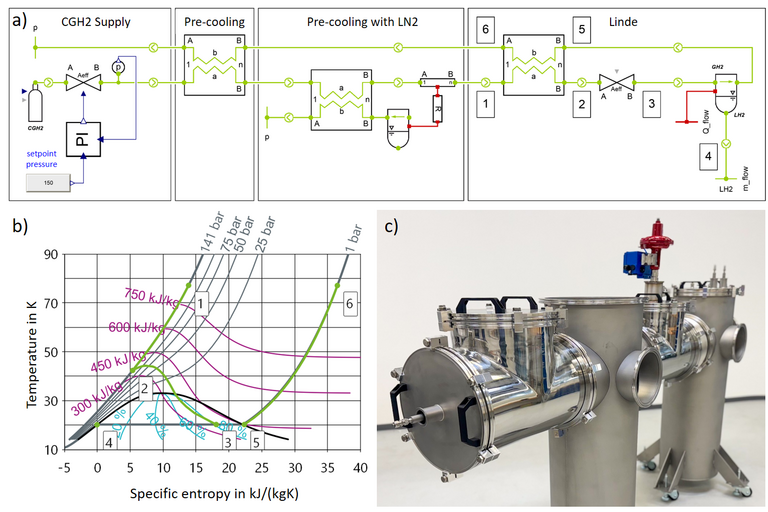
Figure 2: Liquid hydrogen in simulation and measurement: Compressed hydrogen gas is pre-cooled using LN2 and then liquefied using the Linde-Hampson process. a) Flow diagram of a dynamic simulation model of a corresponding H2 liquefaction plant. b) T-s diagram of hydrogen from the simulation of the Linde process for H2 liquefaction. Hydrogen states are visualized at various points along the flow path. c) The implementation of the actual laboratory plant is also being carried out at TLK-Thermo
Refueling Station Concepts and Refueling Processes
We compare, evaluate, and optimize system topologies as well as operating strategies of hydrogen refueling station systems using model-based design and performance analysis. For this, we leverage component models from TIL Suite and the hydrogen-specific Hydrogen Energy Systems Add-On.
Some examples of the analyses we perform for our customers are:
- Analysis of refueling processes (unloading and loading processes) of stationary and mobile hydrogen storage systems, e.g., tube trailers, refueling station and vehicle storage systems
- Analysis and optimization of refueling station concepts, e.g., cascade vs. booster refueling, operating strategies for refilling refueling station storage tanks, and the power and energy demand of the refueling station
- Model-based and automated determination of special refueling protocols using our software MoBA Automation – based on SAE J2601(-5) or individual customer requirements
- Model-based prediction of subsystems, e.g., H2 precooling (temperature and cooling capacity) or storage capacities
For the analysis of hydrogen refueling processes, we have developed a web app in collaboration with the Thermal Science Lab at the TU Braunschweig as part of the THEWA research project. Our refueling station simulator offers the opportunity to simulate and analyze a typical hydrogen refueling process free of charge. An introduction to using the web app can be found on the TLK-Thermo YouTube channel.
Please feel free to use our hydrogen refueling station simulator!

H2 Energetic Utilization
Fuel Cell Systems
In fuel cells, electrical energy and heat are released through electrochemical reactions. Today, hydrogen fuel cells, in which hydrogen and oxygen react to form water, are the most widely used. Together with our customers and partners from industry and research, we are working on the model-based design, analysis, and optimization of low- and high-temperature fuel cells. We draw on our many years of experience in the development of fuel cell systems from numerous service and research projects.

Figure 4: Flow diagram of a dynamic simulation model of a typical mobile fuel cell system with active recirculation of excess hydrogen in the fuel cell’s anode exhaust gas
Based on our Add-On Hydrogen Energy Systems, we develop customized fuel cell systems that are tailored to specific customer requirements. We use modular models for fuel cell stacks that can represent a wide range of physical and electrochemical details, as well as specific models for system components such as membrane humidifiers, jet pumps, and reformers. Detailed material data models, which are part of our substance data library TILMedia, are used to describe gas mixtures with dynamic mixing ratios. This forms the basis for investigating essential physical effects and dependencies at the component and system level.
For our customers, we handle the following areas of responsibility and applications, for example:
Fuel Cell Stack

Figure 5: Flow diagram of a dynamic simulation model of a fuel cell system featuring a combustion chamber for burning excess hydrogen in the fuel cell’s anode exhaust gas and a micro-gas turbine as an additional energy source
- Analysis of the water content and the underlying media conditioning of the supply gases with regard to stable and efficient operation
- Modeling and simulation of cathode-side membrane humidifiers for air conditioning
- Anode-side purge and recirculation strategies for controlling the hydrogen concentration
- Design of efficient thermal management systems for fuel cells
H2 Derivatives (Substance Utilization)
H2 as Feedstock for Power-to-X Processes
Power-to-X (PtX) is a generic term for technologies that can be used to produce synthetic basic materials and fuels from electrical energy using hydrogen and a carbon source. We offer customers who use this technology support through our simulation models. We use reactor models optimized for system simulation to represent chemical reactions such as steam reforming or the water gas shift reaction.
We offer the following specific services, for example:
- Calculation of the suitable composition of the synthesis gas (power-to-syngas) in high-temperature co-electrolysis in an SOEC/rSOC with subsequent methanation
- Modeling and simulation of gas treatment processes to achieve high-purity product gases in adsorption plants using the Adsorption Add-On for TIL
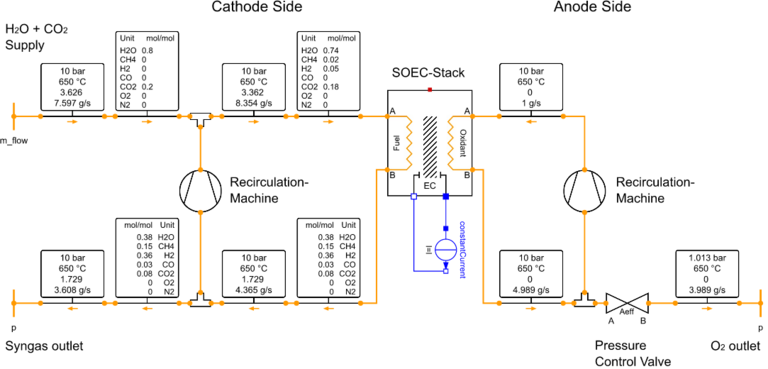

Figure 7: Flow diagram of a dynamic simulation model of high-temperature co-electrolysis in an SOEC system with internal methanation, including spatially resolved results for the composition of the synthesis gas along the fluid channel and for the local current density distribution
Using the Process Systems Library (PSL) from our partner company TLK Energy, we analyze advanced chemical processes for the synthesis of derivatives:
The PSL is compatible with our software TIL Suite, enabling us to perform precise thermal analysis of these processes.